


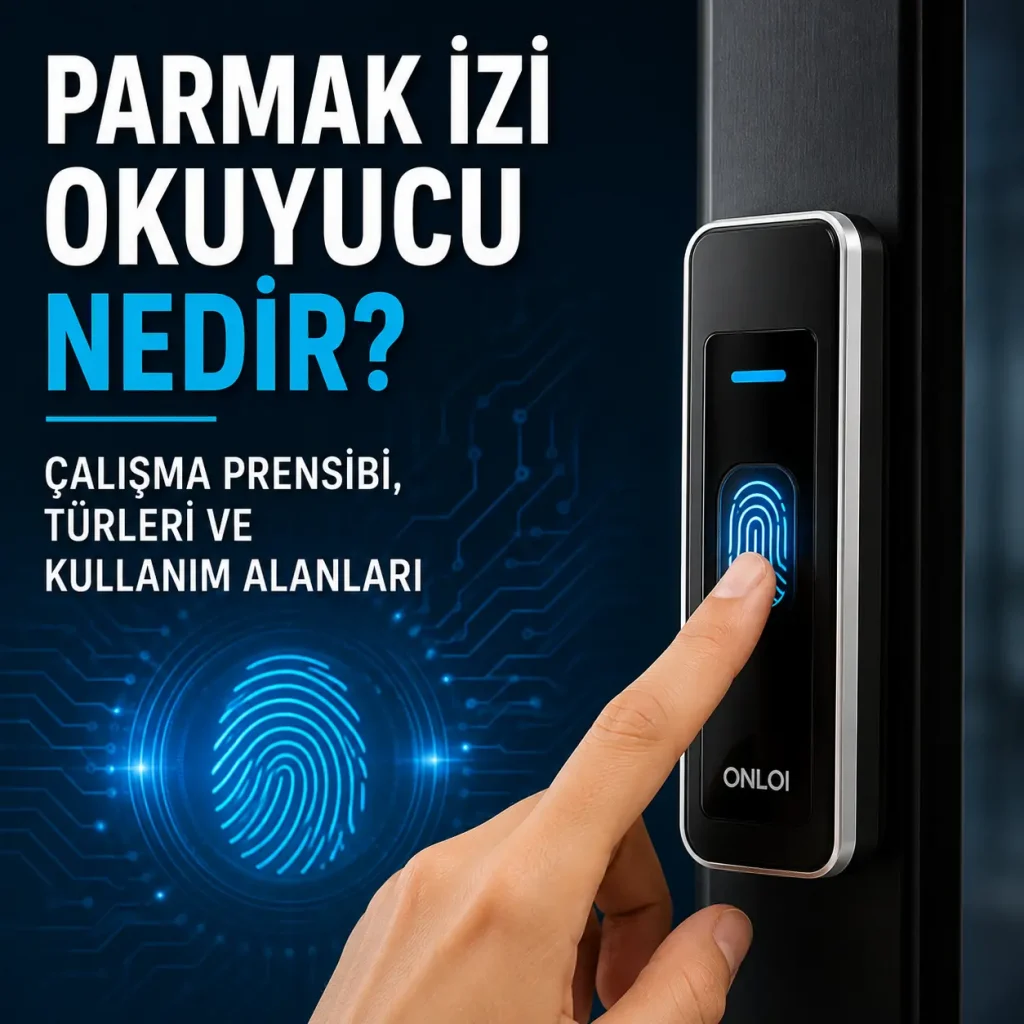
As security technologies continue to advance rapidly today, biometric authentication systems are increasingly being used in many areas of our lives. Fingerprint readers, one of the most common examples of these technologies, enable identity verification by utilizing individuals’ unique biometric characteristics. Used in a wide range of applications—from smartphones to access control systems, and from computers to high-security facilities—these devices both enhance security and offer ease of use.
In this article, you’ll find detailed information about what a fingerprint reader is, how it works, the different types available, and where they’re used.
What Is a Fingerprint Reader?
Fingerprint reader, is an electronic device that verifies a person’s identity by analyzing the unique lines and patterns on their fingertips. Since everyone’s fingerprint pattern is different, this technology is considered one of the most secure methods of identity verification.
Fingerprint readers convert the biometric data collected from the user into a digital template and store it in the system’s memory. When the user wishes to authenticate again, the newly scanned data is compared with the stored template, and access is granted if there is a match.
This method reduces the need to carry physical keys, cards, or passwords while also enhancing security.
What Is a Fingerprint?
"Fingerprint" is a term that means "fingerprint" in English. In technology and security systems, the concept of a fingerprint refers to the digital analysis of the unique patterns on a person’s fingertip and their use for identity verification.
Today, fingerprint technology is used in many areas, such as smartphones, laptops, employee time-and-attendance systems, banking applications, and smart door locks.
How Does a Fingerprint Reader Work?
Fingerprint readers create a digital record by scanning the user’s fingerprint during the initial setup. This record is stored not as an image of the fingerprint itself, but as a mathematical model of the characteristic points on the finger.
When the user touches the sensor again, the system performs a new scan and compares the results with the stored data. If the match exceeds the specified security level, the user is granted access.
This process typically takes less than a second and provides a very fast experience for the user.
Types of Fingerprint Readers
Fingerprint readers are manufactured using various technologies. The type of sensor used can directly affect the accuracy rate, scanning speed, and security level.
Optical Fingerprint Readers
Optical sensors work by scanning an image of a fingerprint using light. This technology, which has been in use for many years, is widely preferred due to its cost advantage. It is used particularly in entry-level security systems and certain access control applications.
Capacitive Fingerprint Readers
Capacitive sensors analyze the ridges and grooves on a finger by measuring electrical changes. Because they offer a higher level of accuracy, they are widely used in many smartphones and professional security systems today.
Ultrasonic Fingerprint Readers
Ultrasonic sensors use sound waves to create a three-dimensional map of the finger. Because this technology offers high accuracy and advanced security features, it is becoming increasingly common in next-generation devices.
Thermal Fingerprint Readers
Thermal sensors verify identity by analyzing temperature differences on the surface of a finger. This technology, which has more specialized applications, may be preferred in applications that require a high level of security.
Advantages of Fingerprint Readers
Fingerprint readers One of its most important advantages is that it uses the user’s unique biometric data. It eliminates problems such as losing keys or forgetting passwords, while providing a fast and convenient access experience. It can also enhance security by making it more difficult for unauthorized individuals to gain access.
In addition to fingerprint authentication, many modern systems also support passwords, cards, or mobile apps. This allows users to take advantage of alternative login methods when needed.
Applications of Fingerprint Readers
Fingerprint readers have a wide range of applications today. They are used for many different purposes, from unlocking smartphone screens to verifying mobile banking transactions. While they are commonly used in employee attendance tracking systems at workplaces, they are also used for access control in data centers and high-security facilities.
With the growing popularity of smart home technologies in recent years, door locks with fingerprint readers have also become increasingly popular. Homeowners can securely unlock their doors without having to carry physical keys, while businesses can more easily manage authorized access.
Fingerprint Readers and Smart Lock Systems
Fingerprint readers have become one of the key components of many smart door locks today. However, modern smart lock systems are not limited to fingerprint authentication alone. Various other methods, such as QR codes, PINs, mobile apps, and temporary access authorizations, can also be used.
This allows users to explore options that best suit their needs without being limited to a single access method. Smart door locks that offer multiple access options—particularly in homes, offices, and short-term rental properties—provide greater flexibility.
Conclusion
Fingerprint readers play a significant role among biometric technologies that provide secure and fast authentication. Developed using various technologies—such as optical, capacitive, ultrasonic, and thermal—these systems are used today in many fields, ranging from smartphones to security systems.
Fingerprint readers offer significant advantages, particularly when it comes to access control and door security. However, in line with the needs of today’s users, smart lock systems that supplement fingerprint authentication with methods such as QR codes, passwords, or mobile access can provide a more comprehensive security and user experience.


