


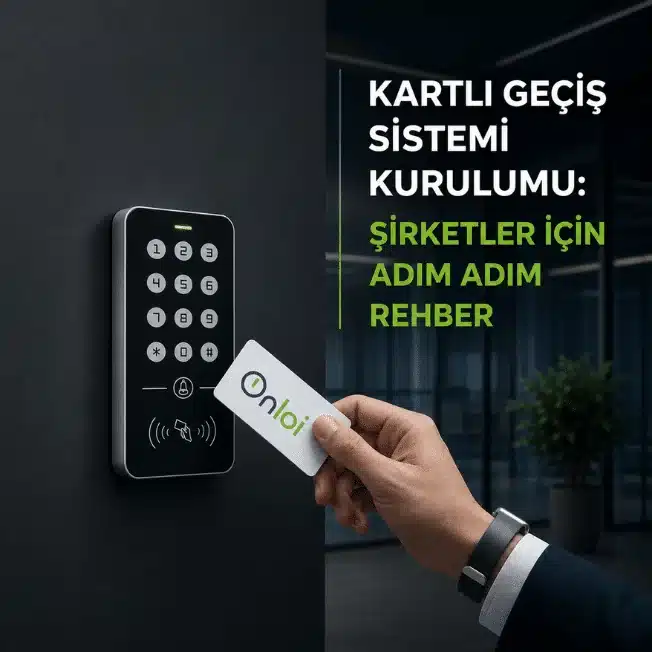
As businesses grow, security and access management becomes more complex. Key delivery processes, unauthorized entries, visitor tracking and management of personnel movements start to create an operational burden over time. For this reason, many companies today are moving away from the use of physical keys and turning to card access systems.
A well-planned card access system not only increases security, but also facilitates personnel management, speeds up entry and exit processes and creates a more controlled working environment throughout the enterprise.
What are the steps involved in setting up a card access system? What should companies pay attention to? In this guide, we take the process step by step.
What is Card Access System?
A card access system is an electronic access control solution that allows designated people to access designated areas. Users are identified to the system with RFID cards, key fobs, mobile IDs or similar authentication tools and can only enter the areas they are authorized for.
Unlike traditional key systems, access authorizations can be managed digitally. Adding new staff, removing authorizations or defining access permissions to specific areas can be done in minutes.
Today, these systems are used in many different structures from offices to factories, from plazas to educational institutions.
Why Do Companies Need a Card Access System?
As the number of employees in a business increases, it becomes difficult to manage security processes manually. Especially in structures with different departments, everyone's access to every area can pose security risks.
With card access systems, access authorizations can be defined according to certain rules. Thus, only authorized personnel can pass through certain doors, critical areas can be protected and all entry and exit movements can be recorded.
In addition, physical key losses, copying risks and key delivery processes are eliminated. This provides a significant operational advantage, especially in companies with high personnel turnover.
Conduct a Needs Analysis before Installation
Installing a card access system does not start with device selection. The first step is to analyze the needs of the business correctly.
First of all, it should be determined which areas will be under control. Main entrance doors, office areas, production areas, warehouses or executive rooms may require different levels of security.
At this stage, the number of employees, visitor density, shift working system and future growth plans should also be evaluated. Because systems installed without proper projecting may be insufficient in the future.
Determining the Appropriate Access Control Infrastructure
After the needs are clarified, the access control infrastructure to be used is determined. The needs of every business are not the same.
Some companies may only want to control office entrances, while others may want to centrally manage dozens of different points in multi-storey buildings. For this reason, the software infrastructure, control panels and reader technologies to be used should be selected according to the structure of the business.
Especially for businesses with growth potential, choosing scalable systems provides cost advantages in the long term.
How Does RFID Access System Work?
RFID access system is one of the most widely used access control technologies today. When the RFID card or key fob is brought close to the reader, the system verifies the user information and grants access if the necessary authorization is available.
Thanks to its contactless operation feature, it provides ease of use and offers fast passage in businesses with heavy entry and exit traffic.
RFID technology also helps digitally manage processes such as personnel tracking, visitor management and access reporting.
Importance of Integration with Personnel Tracking System
Many businesses consider a card access system for security purposes only. However, a properly configured system can also support personnel tracking processes.
Employees' entry and exit times can be recorded, shift patterns can be tracked and various reports can be generated. Thus, human resources processes and security management can be brought together in a single structure.
Especially in production facilities, logistics centers and large-scale offices, this integration provides significant operational advantages.
When Should Turnstile Access System Be Preferred?
In buildings with high employee and visitor traffic, the use of card readers alone may not be sufficient. In such cases, turnstile access systems are preferred.
Turnstiles increase the level of security by not allowing physical passage without authorization. It also enables more organized management of entrances and exits.
Turnstile systems are frequently used in plazas, factories, campuses, public institutions and large corporate buildings. It offers centralized management by working integrated with card access infrastructure.
Considerations After Installation
The process is not complete after the card access system is installed. Regular management and maintenance processes must also be planned for the system to be used effectively.
Identification of new employees, de-authorization of departing personnel and updating access policies should be regularly monitored. In addition, software updates and system controls should not be neglected.
Regularly maintained systems operate more safely and offer high performance for many years.
Mistakes When Choosing a Card Access System
One of the most common mistakes companies make is to act only according to current needs. However, access control systems are long-term investments and the future growth plans of the business should also be taken into account.
Choosing systems with insufficient capacity, ignoring software integrations or making decisions based solely on cost may lead to additional investment needs in the future.
Therefore, when choosing a system, scalability, technical support and integration capabilities should be evaluated as well as security needs.
Conclusion
Today, card access systems have become not only a security solution, but also an important operational tool that digitizes the access management of businesses. A properly planned system increases security, facilitates personnel management, speeds up entry and exit processes and contributes to corporate efficiency.
During the installation process, needs analysis, selection of appropriate infrastructure and consideration of future growth plans are critical to a successful project. Therefore, when evaluating access control systems, not only today's needs but also the future needs of the business should be taken into consideration.
If you want to determine the most suitable card access system solution for your company or evaluate your project needs, you can get detailed information by contacting Onloi experts and plan the system suitable for your business together.
For detailed information: https://onloi.com/iletisim/


