


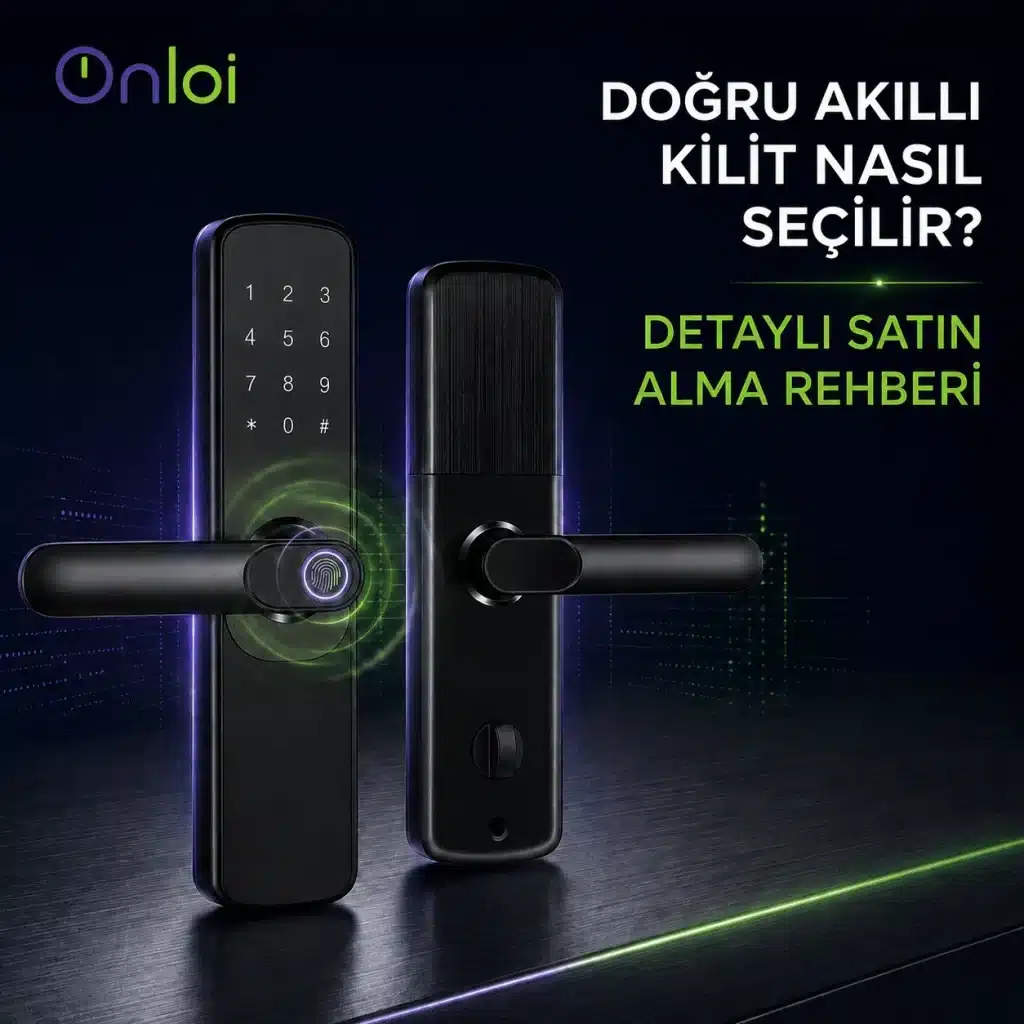
With the widespread use of smart home technologies, door security is undergoing a significant transformation. Smart locks, which were preferred only by technology enthusiasts until a few years ago, are now used in many different areas from homes to offices, from apartments to short-term rental apartments. The most important reason for this is the comfort, security and remote control advantages they offer.
However, the large number of brands and models on the market can make it difficult for users to make a decision. When choosing between fingerprint reader models, card access systems, Wi-Fi connected products or mobile application supported solutions, it is important to know which features are really important.
In this guide, we take a detailed look at the criteria to consider when buying a smart lock, the most important needs for home and office use, and the key points you need to know to choose the right product.
What is a Smart Lock?
A smart lock is an electronic access control system that reduces or completely eliminates the use of traditional keys. Instead of a physical key, users can open the door via fingerprint, facial identification, password, mobile app, RFID card or Bluetooth connection.
In traditional locks, access management is carried out entirely through physical keys, while in smart locks this process is digitally controlled. This makes it much easier to define new users, change access authorizations or track entry and exit records.
Especially in recent years, with the increase in security expectations and the widespread need for remote management, smart locks have become more preferred by individual and corporate users.
What to Consider When Choosing a Smart Lock
Safety Level Comes First
No matter how advanced a smart lock is, its main task is to provide security. For this reason, the first issue to be evaluated in the purchasing process is the security infrastructure.
A quality smart lock does not rely solely on a single access method. It combines different authentication options such as fingerprint, facial identification, password, card and mobile app. This provides ease of use and creates alternative entry methods in case of a possible access problem.
From a security perspective, systems that offer multiple authentication support are always more advantageous. Access options suitable for different user profiles provide great convenience, especially in homes used by families or offices with high employee traffic.
Always Check Door Compatibility
One of the most common mistakes when buying a smart lock is not investigating its compatibility with the existing door. However, not every lock can be properly installed on every door.
Steel doors, wooden doors, glass doors, apartment entrance doors or office doors have different installation requirements. Choosing the wrong product can both create additional costs and negatively affect the performance of the product, or it may not be used at all on the existing door.
For this reason, it is very important to determine the technical specifications of your door and examine the compatibility information of the product before purchasing. It should not be forgotten that additional modifications to be made later may cause cost and time loss.
Mobile App Experience Affects Long-Term Usage
Many users focus on product features and ignore the quality of the mobile app. However, most of the smart lock experience is lived through the app.
Being able to open the door remotely, create temporary access (password) for guests, edit user authorizations and view entry and exit movements are among the features most demanded by users today.
While a simple and stable application facilitates daily use, complex or slow running applications can seriously negatively affect the user experience. For this reason, attention should be paid not only to the hardware features but also to the software infrastructure before purchasing.
Quality of Fingerprint Technology Matters
Fingerprint and facial recognition are standard in many smart locks today. But not all sensors perform the same.
While high-quality sensors quickly recognize the finger and human face, detection errors are more common in low-quality systems. Sensor performance directly affects user satisfaction, especially in environments with intensive use.
When choosing a smart lock with fingerprint identification, the sensor's response time, accuracy and ability to recognize different users should be taken into account. Because fingerprints are often the most frequently used access method in daily use.
When choosing a lock with face identification, the depth sensor hardware in particular should be checked separately. This is essential for accurate and stable identification.
Learn what to do in case of electrical or battery problems
One of the most common questions asked by users of electronic systems is what happens when the battery runs out. Quality smart locks offer various security scenarios for such situations.
Low battery warnings, emergency energy inputs and mechanical key support are critical here. So that users do not lose access to the door in unexpected situations.
Although these details are often overlooked during the purchasing process, they are very important for long-term use.
Remote Management Features Become the Standard of the Future
One of the biggest advantages of smart locks is that they reduce the need for physical keys. Especially thanks to the remote access feature, users can control the door from anywhere in the world as long as they have a wifi connection.
Homeowners can create temporary access for their guests, office managers can authorize employees to enter during certain hours, or businesses can give time-limited access to service teams.
These features not only provide comfort, but also facilitate operational processes.
Choosing a Smart Lock for Home
Home users' priorities are often balanced between security and ease of use. Smart locks offer significant advantages, especially for families with children, frequent travelers or users who want to eliminate the habit of carrying keys.
A smart lock for home use should include features such as quick fingerprint entry, control via mobile app, guest access, and low battery notifications.
Ease of installation and practicality of daily use should also be taken into consideration. Because a technologically powerful product may not provide the expected benefit when it is complex to use.
Choosing a Smart Lock for the Office
The needs are different in offices compared to home use. Due to the high number of employees, visitor traffic and access management requirements, more advanced features stand out on the corporate side.
Especially user authorization, keeping entry and exit records and managing access levels are of great importance for offices. Digital access systems that eliminate turnkey processes both increase the level of security and reduce operational burden.
This is one of the main reasons why many organizations, from small businesses to large corporate structures, are turning to smart lock systems.
The Most Common Mistakes When Buying a Smart Lock
Many users try to make a decision by comparing only price during the purchasing process. However, smart locks are security products that will be used for many years and should not be evaluated solely on cost.
The most common mistakes include buying products without checking door compatibility, not investigating technical service support, not reviewing the mobile app experience or ignoring battery scenarios.
In addition, focusing only on product features and not evaluating after-sales support processes can also create dissatisfaction in the long run. For this reason, the support infrastructure offered by the brand should be considered as much as the product.
Conclusion
The best smart lock is not the same product for everyone. The right choice depends on the intended use, door type, access scenarios, security expectations and management needs.
For home users, ease of use and remote control features come to the fore, while multi-user management and access tracking become more important in offices. Therefore, the purchasing process should focus not only on technical features but also on daily use scenarios.
Choosing a smart lock system with a high level of security, user-friendliness and long-term support not only increases the comfort of living but also allows you to manage property security more effectively.
If you are not sure which smart lock is right for you, you can talk to Onloi experts to find out which solution is right for your needs. You can get detailed information about products, installation processes and usage scenarios by phone or via the contact form.
For detailed information: https://onloi.com/iletisim/


