


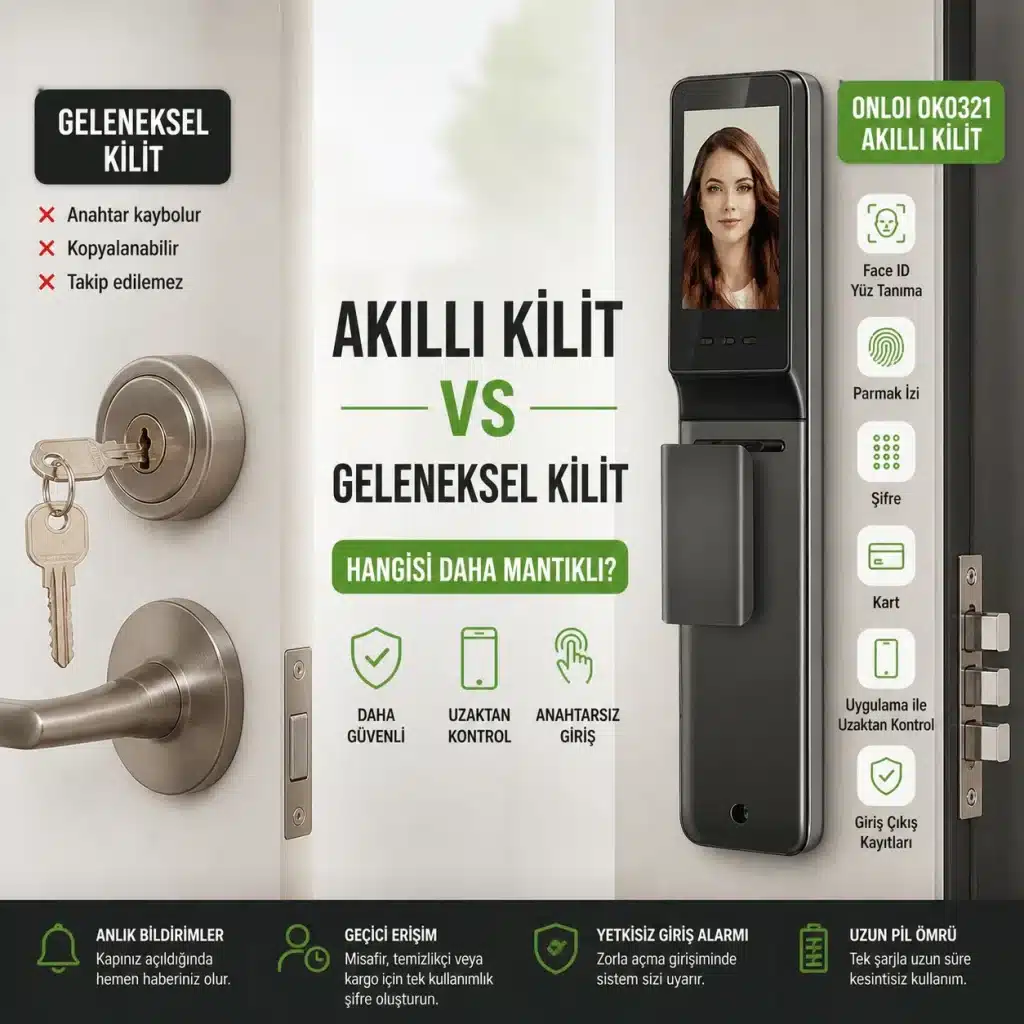
Choosing a door lock used to be a simple decision. But not anymore. Even in budget grocery stores "fingerprint lock" and "app-controlled lock". But does this technological breakthrough really make a difference, or is it just a fashion choice? In this article we honestly compare the smart lock with the traditional mechanical (keyed) lock in terms of security, price and everyday use.
Fundamental Difference: How Do They Work?
A traditional lock is a mechanical system operated by a metal key. The key aligns the series of pins in the cylinder and the deadbolt opens. It is a mechanism that has not changed for centuries. A smart lock, on the other hand, consists of a small electronic control card, an authentication module (fingerprint sensor, card reader, PIN panel or Bluetooth receiver) and a motor or solenoid mechanism that processes the signal and opens the door. Once an identity registered in the system is verified (this can be a fingerprint, a password or a phone signal), the door opens. This whole process is usually completed in under a second.
Safety Comparison
Vulnerabilities of Traditional Lock
Mechanical locks are vulnerable to "master key" attacks, key duplication and brute force coercion. A lost or stolen key necessitates lock replacement. Furthermore, it is not possible to track when the person using the key enters the lock.
Security Advantages of Smart Lock
Smart locks unreplicable authentication. Fingerprints or facial recognition are biometric data that are extremely difficult to physically forge. Beyond that:
- Entry-exit registration: The time at which the door is opened and closed is recorded through the application.
- Push notification: You will receive a notification on your phone when the door is opened.
- Temporary access: A single-use password can be defined for your cleaner, delivery person or guest, valid only during certain hours.
- Unauthorized entry alarm: In case of a forced opening attempt, the system will alarm and warn the user.
- Immediate cancellation: You can remove access to a dismissed employee or a departing tenant in seconds.
Price and Economic Comparison
The initial cost of a smart lock is higher. But the picture changes when looking at the long-term picture.
| Criteria | Traditional Lock | Smart Lock |
|---|---|---|
| Initial purchase cost | Low (300-1,500 TL) | Medium-High (3,000-15,000 TL+) |
| Key duplication | Cost for each copy | Not required |
| Lock change (loss of key) | 500-2.000 TL | Password/profile update - free of charge |
| Maintenance requirement | Periodic lubrication, cylinder replacement | None (except battery replacement) |
| User Copy Status | The lock must be completely replaced | User profile is deleted |
| Additional features (remote access, recording, biometric identification sensor hardware) | No | Included (including face, fingerprint, palm ii scanning) |
Real cost analysis: When there is a staff change of 10 people in a building, the traditional system requires collecting and checking keys each time and replacing all cylinders when necessary, whereas with the smart system, authorization is removed with a few clicks. When labor and lost key costs are added up, the smart lock usually pays for itself within 2-3 years.
It also minimizes many security risks thanks to its ability to provide temporary passwords, protecting you from possible financial damages.
Ease of Use
In a traditional lock, a physical key is required for each entry. If the key is forgotten, the door is locked. More than one door means more than one key.
Smart lock your fingerprint or your phone is enough. Remote access means you can open the door for your guest even when you are not at home. For older people and children, the fingerprint or PIN method is much more practical than searching for keys.
A smart lock offers distinct advantages over a traditional lock, both in terms of security and long-term economics. Flexibility in access management, record-keeping capacity, remote manageability and the elimination of key costs position smart locks as the most reasonable option.
Would you like to find out which smart lock system is right for your home, office or apartment door?


