


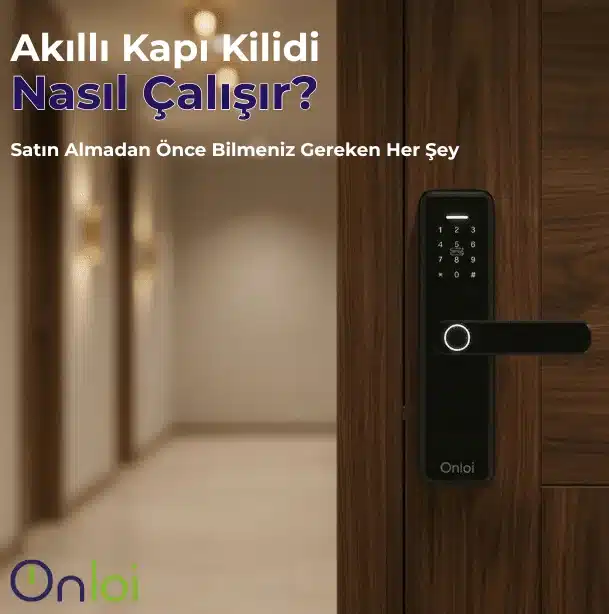
You reach for the door of your home or office dozens of times every day. You look for a key, turn it, look back to see if it locks. But now door locks have come to the point of eliminating this routine completely.
Smart door locks today are not just about "fingerprint instead of key". We are talking about systems that can authorize access, keep a record of entry and exit, alert you before the battery runs out, be controlled remotely via your phone and even continue to work even if the power is cut.
In this guide, we will explain exactly how a smart door lock works, which technologies do what and which model makes sense for your situation.
What is a Smart Door Lock?
A smart door lock is a security system that replaces the traditional mechanical lock and works through electronic authentication methods. The main difference is this: a mechanical lock only recognizes the physical key. A smart lock can recognize a fingerprint, password, smart card, bluetooth signal or a combination of these.
The heart of the system is a small electronic control board. This board receives the signal from the authentication components, compares it with the data stored in the system and, if there is a match, triggers the motor or solenoid mechanism that opens the door. This whole process is usually completed in under a second.
Which Technologies are Used?
Smart door locks can combine multiple authentication methods. Each method has its strengths and weaknesses, and you need to look at each one individually to understand which one is right for you.
A fingerprint reader is one of the most common methods. The sensor, placed on a door handle or surface, converts the unique lines in the dermal layer of the finger into numerical data and compares them with templates stored in the system. Modern sensors complete this process in under 0.3 seconds. The biggest advantage is that it doesn't need anything portable.
Palm scanning is It is a biometric method similar to fingerprinting, but stands out in that it works without the need for contact. The vascular tissue on the palm of the hand is scanned with infrared rays and since this pattern is unique to the individual, it is extremely difficult to imitate. Compared to fingerprint readers, it provides much more reliable results even on damp or dirty hands. With this feature, it stands out as a preferred method in areas where hygiene standards are kept high, such as food, health and production sectors.
PIN code entry is the most preferred method after fingerprinting. A code ranging from four to eight digits is entered. Even a four-digit code offers 10,000 different combinations, making brute force attacks physically very difficult. Flexibility, such as giving a temporary code to a guest or defining a code valid at a certain time, is its greatest strength.
RFID and smart card technology has become standard in hotels and corporate buildings. The chip in the card or key fob communicates with the reader on the lock via radio frequency. From the central software of the system, which card can enter which door and at which times can be programmed minute by minute. Even on an employee's last day of work, you can instantly cancel the authorization of their card.
Bluetooth and Wi-Fi enabled models turn your smartphone into a key. In Bluetooth models, automatic unlocking can be activated when the phone is within a certain distance of the door. You can also connect your smart lock to the internet with a gateway device and have remote access.
With Wi-Fi enabled systems, you can lock and unlock your door from anywhere in the world, define temporary access for guests and receive instant entry and exit notifications.
The biometric facial recognition and palm scanning system is the highest level of technology. It creates a 3D map of the face through infrared sensors, making it almost impossible to fool with a photo. It works even in the dark. It provides great convenience in high-traffic areas or in environments where hands are busy, such as warehouses, hospitals, factories.
Login option with physical key is a safeguard that smart locks are completely indispensable. In the unlikely event of a dead battery, system failure or user error, most models have a hidden mechanical cylinder entry. This entry is not intended for daily use, it is a backup emergency access point. Because it is incorporated into the design, it is visually inconspicuous, so it can be activated when needed without disturbing the smart nature of the lock.
Power Supply and What Happens in a Power Failure?
This is one of the first questions most people ask, and the answer is more satisfying than you might think.
The vast majority of smart locks are battery operated. This is actually an advantage because the lock, which is not connected to the central power line, is not affected when the building power is cut. When the battery level reaches a critical level, the system warns you in advance with an audible alert, app notification or on-screen indication. The battery life of most models ranges from 6 to 12 months of normal daily use.
What happens if the battery dies completely? All serious models have a mechanical spare key entry. It is usually invisible or integrated into the design, does not compromise aesthetics, but is a real emergency exit door.
In some models working with solenoid mechanism, emergency opening can be done by connecting a 9V battery from outside. It is enough to touch the battery to the small metal contacts at the bottom of the lock case.
How Secure is a Smart Lock?
The question of whether a smart lock is more secure than a mechanical lock is a question with a seemingly simple answer but a lot of detail.
Cylinder breaking and pulling are the most common methods of attack on conventional locks. The vast majority of smart locks are manufactured with body structures reinforced against these mechanical attacks. Models without a cylinder section or with steel reinforcement are significantly superior to conventional locks in terms of physical strength.
As for electronic hacking, you need to know the following: Models that communicate via Bluetooth or Wifi use encrypted protocols. Products from trusted manufacturers are protected by AES 128-bit or higher encryption standards. Breaking this level of encryption is practically impossible for an ordinary attacker.
However, like any other technology, the security of smart locks is directly proportional to the correct installation, up-to-date software and product selection from reliable manufacturers. Low-cost products from unknown brands may not have security certification and this poses a risk.
In addition, with the sensors in the device, in case of physical damage to the device; the device sends an alarm notification to the phone on which your application is installed, so you can connect to your device camera and take a snapshot.
Which Model for Which Situation?
For residential use, fingerprint and encrypted combination models are the most practical choice. If you want application integration, it makes sense to go for a Wi-Fi supported model. For children or elderly family members, a fingerprint reader is both easy and safe.
For office and workplace use, systems with RFID cards or access control software should be preferred. If you work with large teams, a system with central management software records who enters where and at what times and allows you to change the authorization instantly.
Card or mobile key supported systems are standard for hotels and accommodation businesses. Systems that work integrated with guest check-in and check-out processes and can be managed from the front office make a difference in terms of both operational efficiency and guest experience.
Gymnasiums, educational institutions and public buildings require electronic locker locks and access control points. In these applications, both durability and easy management must be prioritized.
How long does the installation take?
Installation of a smart lock compatible with a standard door is completed in 30 minutes to 1 hour for most models. This process, which consists of door handle, escutcheon and cylinder replacement, does not require any intervention on the door. However, since corporate installations involving access control systems require wiring and software integration, it is recommended to be done by an authorized technical team.
What to Check Before Buying
Familiarize yourself with the type of door you are using and the thickness of the door, because not every lock is compatible with every door. Check whether the product carries CE, TSE or international safety certificates. Ask whether software and application support is constantly updated. Clarify the scope of after-sales technical support.
Onloi has a significant advantage: availability of spare parts, Turkish technical support and compliance with door standards in Turkey. For imported products, the warranty coverage and spare parts process can create serious time and cost problems.
Choosing a smart lock system should be based on both your current needs and future growth plans. You may want to start with one door and integrate the whole building, choosing an infrastructure that supports this will save money in the long run.
As Onloi, we offer smart door lock, access control system and electronic cabinet lock solutions with domestic production. You can contact us for product comparison or technical consultancy specific to your project.
To review Onloi's most preferred smart door lock models shop.onloi.com You can visit the address.


