


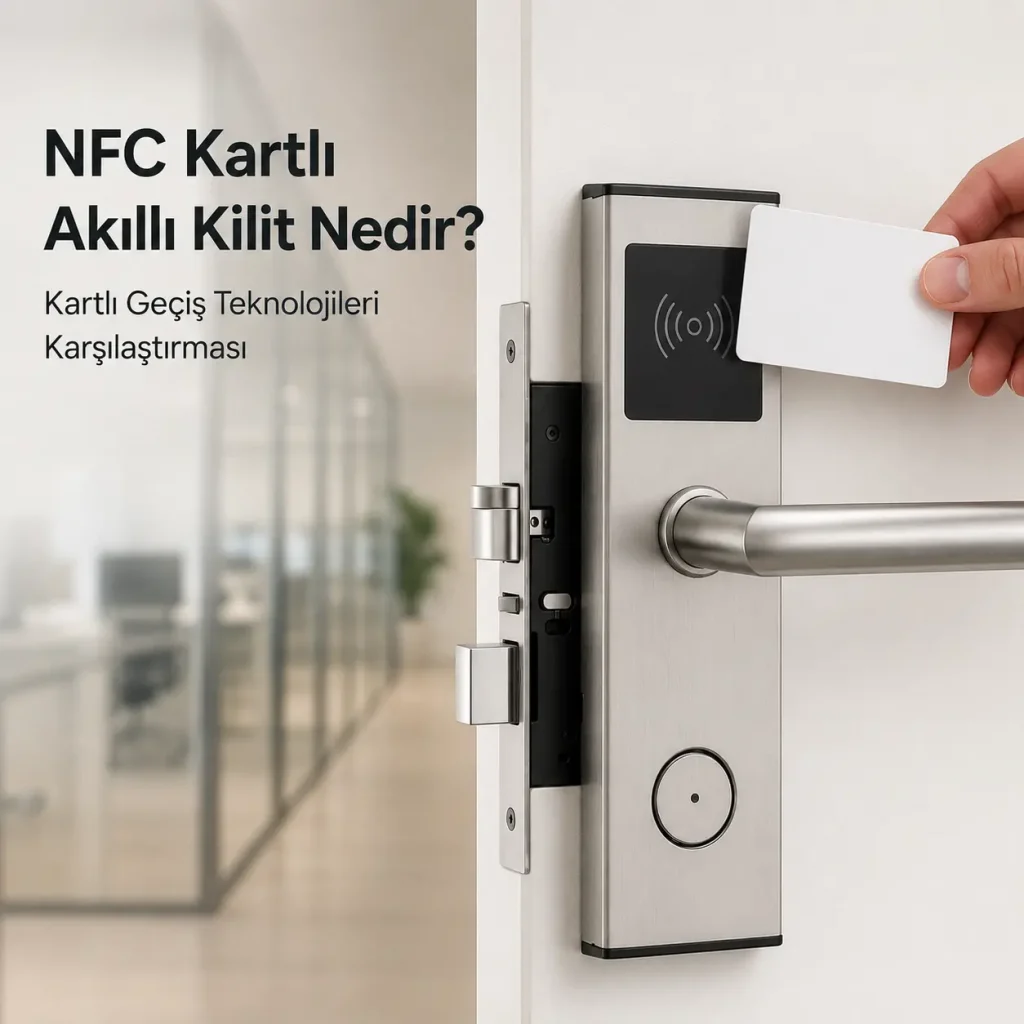
Card-based access control systems are among the most popular technologies used today to provide secure access in a wide range of settings, from residential buildings to corporate facilities. By eliminating the need to carry keys, these systems are becoming increasingly popular thanks to both their ease of use and advanced security features. In particular, Smart lock with NFC card These solutions offer a more modern and flexible user experience compared to traditional card-based systems. However, card-based access technologies are not limited to NFC; Proximity and MIFARE card systems have also been in use for many years in various projects. Understanding the differences between these technologies is crucial for selecting the right product.
What Is an NFC-Enabled Smart Lock?
Smart lock with NFC card, is an electronic access system that allows the door to be opened only via authorized NFC cards or NFC-enabled smartphones. NFC (Near Field Communication) technology uses short-range wireless communication, and the authentication process is completed within seconds when a card or phone is held close to the lock. Once authorization is verified, the door opens automatically. Because it eliminates the need to carry keys, provides quick access, and is compatible with smartphones, it is widely used today in smart homes, offices, hotels, and residential projects.
How Does a Card-Based Smart Door Lock Work?
One card-based smart door lock...reads the unique identification information on the card and compares it with users registered in the system. When authentication is successful, the electronic lock engages and the door opens. Today, many systems go beyond card-based authentication alone; they work in conjunction with different authentication methods—such as passwords, fingerprints, mobile apps, or Bluetooth—to provide a higher level of security. This not only enhances the user experience but also makes access control more secure.
What Are Card-Based Access Control Technologies?
The most commonly used technologies in card-based access control systems are Proximity, MIFARE, and NFC. Although they look quite similar, their operating principles, security levels, and data storage capacities differ from one another. When selecting the right technology, it is essential to evaluate not only cost but also security requirements and usage scenarios.
What Is a Proximity Card?
One of the most frequently searched questions on Google “What is a proximity card reader?” This is the question. Proximity cards are a basic card-based access control technology that operates at a frequency of approximately 125 kHz and has been in use for many years. In these systems, the user is authenticated by reading the serial number on the card. Although they offer cost-effective solutions thanks to their simple design, they do not incorporate advanced encryption technologies. As a result, the risk of card cloning is higher compared to newer technologies. Although they are still used for small businesses, apartment building entrances, or basic employee access systems, they are not preferred for projects requiring high security.
What Is a MIFARE Card?
MIFARE cards, on the other hand, are considered a more advanced version of card-based access control technologies. Operating at a frequency of 13.56 MHz, these cards are much more secure than proximity cards thanks to their advanced encryption infrastructure. The card can store not only identification information but also various data fields. This allows the same card to be used for door access, cafeteria systems, and employee tracking applications. Hotels, hospitals, universities, and corporate companies, in particular, prefer MIFARE technology due to its high level of security.
Are NFC and MIFARE the Same Technology?
This topic is also among the questions users frequently ask. NFC and MIFARE are not the same technology, but they can work together. NFC is a short-range wireless communication standard. MIFARE, on the other hand, is one of the card technologies that can use this communication standard. Today, many Smart lock with NFC card...it can read MIFARE cards and also allows NFC-enabled smartphones to be used as digital keys. This enables users to securely unlock the door using either their cards or their phones.
Differences Between Proximity and MIFARE Cards
When comparing card technologies, the biggest difference lies in the level of security. While proximity cards offer only basic authentication, MIFARE cards provide a much more secure structure thanks to advanced encryption algorithms. Additionally, MIFARE cards can store more data, integrate with different systems, and are very difficult to duplicate. Although proximity cards offer the advantage of low cost, they may prove insufficient for projects requiring advanced security. For this reason, MIFARE and NFC technologies are now much more widely used in next-generation access control systems.
What Is an Encrypted Card Reader?
Another topic of interest is encrypted card reader These are two-factor authentication systems. In these systems, the user not only swipes their card but also enters the PIN assigned to them. This completes the two-factor authentication process. If a card is lost or stolen, simply possessing the card is not sufficient to open the door. For this reason, encrypted card readers are frequently preferred in areas requiring high security, such as finance departments, server rooms, laboratories, archives, and executive offices.
Which Card Technology Should You Choose?
When selecting card technology, it is important to consider not only current needs but also future use cases. For small projects requiring basic access control, proximity cards may be sufficient. However, if long-term use, mobile access support, advanced security, and centralized user management are desired, MIFARE (13.56 MHz) or NFC-based systems would be a much better investment. NFC-enabled solutions offer significant advantages, particularly in smart building projects and corporate environments, thanks to their ability to integrate with mobile applications.
Conclusion
Card-based access control systems have undergone significant technological advancements and have now moved beyond simply swiping a card. Today, Smart lock with NFC card Thanks to their solutions, high security, fast access, and smartphone support, they have become one of the most important components of modern access systems. However, card-based smart door lock It is also important to consider the card technology used when making a selection. While proximity cards offer cost-effective solutions, MIFARE and NFC-based systems provide a much more robust infrastructure in terms of security, flexibility, and longevity. Choosing the right technology not only enhances the user experience but also ensures that businesses’ access security is future-proof.
Switch to secure, fast, and contactless access with Onloi’s NFC card-based smart lock solutions. Explore Onloi’s smart lock solutions now to discover the card-based access system that best suits your needs and get professional support.


